Cooking Equipment: A Sketch Dingbats Font for Your Brand
As a small business owner, you know that every detail matters when it comes to building a brand that people remember. From your logo to your packaging, from your website to your social media posts, the visual choices you make either strengthen or weaken the connection with your customers. One detail that often gets overlooked is typography—specifically, the decorative accents and icons that add personality to your materials. That is where Cooking Equipment comes in. This dingbats font with a sketch style theme offers a hand-drawn, artisanal look that can bring warmth and character to your business identity.
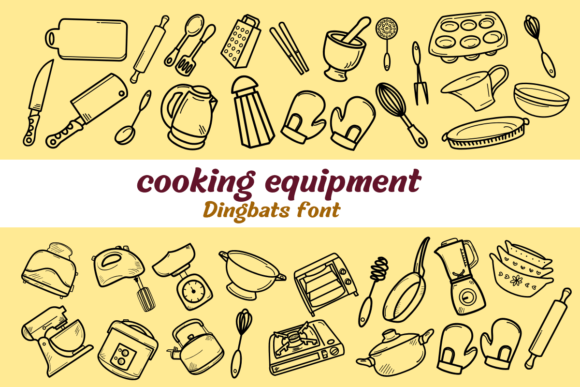
Cooking Equipment is not a traditional alphabet font. Instead, it is a collection of sketch-style illustrations that function as individual characters. Think of it as a ready-made library of hand-drawn icons that you can type out, scale, color, and arrange just like any other font. The style is rough, organic, and full of texture—reminiscent of something drawn with a pencil or a fine-tipped pen on a napkin. This gives your brand a handmade, approachable feel that is hard to achieve with polished vector graphics. For a small business owner, that authenticity can be a powerful differentiator.
Why a Sketch Style Dingbats Font Works for Real Business Materials
When you are running a business, you need design assets that pull double duty. Cooking Equipment does exactly that. Because it is a font file, you can install it on your computer and use it in any program that supports fonts—Word, Canva, Illustrator, Photoshop, InDesign, or even simple text editors. You do not need to hire a designer to create custom icons for every new project. You can simply open a document, select the Cooking Equipment font, and start typing your way to unique visuals.
The sketch aesthetic works especially well for businesses that want to communicate warmth, craftsmanship, or a personal touch. If you run a bakery, a café, a handmade soap company, a farm-to-table restaurant, a catering service, or a kitchenware shop, this font aligns with your brand story. But it also works for businesses outside the food world. Any brand that wants to suggest creativity, care, and a human hand behind the product can benefit from this style.
Real Ways to Use Cooking Equipment Across Your Brand
Let me walk you through some practical applications. These are not theoretical ideas. These are the kinds of materials you create every week as a small business owner.
Logos and Brand Marks
A logo does not always need to be a custom illustration. Sometimes, a well-chosen dingbats character can serve as the perfect brand mark. Cooking Equipment includes individual sketches that can stand alone as a logo icon. For example, if you own a bakery, you might use one of the utensil drawings as a simple, memorable mark. Pair it with a clean serif or sans serif font for your business name, and you have a logo that looks intentional and professional without breaking the bank.
Product Labels and Packaging Design
Packaging is one of the most important touchpoints for any product-based business. Your label needs to communicate quality and personality in a split second. Cooking Equipment can add charm to your packaging in subtle ways. Use a small sketch icon as a decorative element next to ingredients, instructions, or your brand name. The hand-drawn look suggests that your product is made with care, not mass-produced in a factory. For handmade candle labels, beauty product jars, or gourmet spice bags, this approach feels authentic.
Menus, Flyers, and In-Store Signage
If you run a café, food truck, or brick-and-mortar shop, you produce menus and signs regularly. Cooking Equipment can help you create consistent materials that feel cohesive with your brand. Use the dingbats as bullet points, dividers, or decorative borders. Because the style is sketchy and organic, it softens the look of your materials and makes them feel more inviting. Customers respond to that warmth.
Business Cards and Stationery
Your business card is often the first physical impression a potential customer gets of your brand. A small, well-placed sketch element from Cooking Equipment can make your card stand out. Use it behind your contact information as a subtle watermark, or place it near your logo as an accent. The same goes for thank-you cards, invoice templates, and gift tags. Consistency across these small items builds recognition over time.
Social Media Graphics and Digital Ads
Social media moves fast, and you need visuals that stop the scroll. Cooking Equipment works beautifully in Instagram posts, Pinterest pins, and Facebook ads. Because the sketches are hand-drawn, they feel less corporate and more relatable. Use them as image overlays, in Stories, or as part of a branded template. The font loads just like any other typeface, so you can use it in Canva or other design tools without needing to upload image files.
Website Banners and Email Headers
Your website is your digital storefront. Using Cooking Equipment sparingly in your header area, within your hero section, or as a decorative element in your email newsletters adds a layer of personality that plain text cannot achieve. Just remember to use it as an accent, not as body copy. Dingbats fonts are best used as display elements, not for long sentences.
How Cooking Equipment Helps Your Business Look More Professional
There is a common misconception that only expensive, custom design work can make a business look professional. That is not true. Professionalism comes from consistency and intention. When you use the same design assets across all your materials—labels, ads, signage, website—you signal to customers that you are organized and serious about your brand. Cooking Equipment gives you a consistent set of sketch-style icons that you can use everywhere. Because it is a single font file, every character has the same aesthetic. That coherence is what makes a brand feel polished.
Using a premium font like this also tells customers that you care about details. A cheap clip-art icon or a generic emoji does not communicate the same level of effort. A hand-drawn dingbats font shows that you have invested in your brand identity, even if your budget is small.
Readability and Practical Considerations for Business Use
Because Cooking Equipment is a dingbats font, readability in the traditional sense is not the main consideration. You are not using it to write paragraphs. You are using it for icons, accents, and visual punctuation. That said, you still need to think about scale. On small labels or mobile screens, a detailed sketch might lose its clarity. Test the font at different sizes before committing to a final design. Print a sample label. Create a mockup of a social media post. Zoom in and out. Make sure the details remain recognizable at the size you plan to use.
Another practical tip: use Cooking Equipment as a display font or accent font, not as a primary typeface. Pair it with a clean, readable sans serif font for body text and important information. A simple pairing like Cooking Equipment for icons and a neutral sans serif for your business name creates a balanced, professional look.
Font Pairing Ideas That Work
If you are not sure what to pair with Cooking Equipment, here are a few approaches that work well in real business settings:
- With a clean sans serif font: The contrast between a rough sketch and a smooth, modern sans serif creates visual interest. Use the sans serif for your brand name and the dingbats for accents.
- With a readable serif font: A classic serif paired with hand-drawn icons gives a vintage, artisan feel. This works well for bakeries, delis, and handmade goods.
- With a script font: If your brand has a feminine or elegant tone, combining a script with Cooking Equipment can feel cohesive and creative. Just be careful not to overdo it—too many decorative elements can look busy.
The key is to let Cooking Equipment be the expressive element while a simpler typeface does the heavy lifting for readability. This gives your brand personality without sacrificing clarity.
Testing Before You Commit
Before you roll out Cooking Equipment across your entire brand, spend some time experimenting. Download the font and install it on your computer. Try it in a few different layouts. Create a simple logo concept. Design a mock label. Use it in a social media template. Show the results to a few trusted customers or friends and ask for their honest reaction. Does it feel like your brand? Does it communicate the right mood? Testing takes a little time, but it saves you from making a decision you might regret later.
Also, consider how the font works in black and white versus color. Sketch style fonts often look their best in black ink on a light background, but they can also be colored to match your brand palette. Try a few versions and see what feels right.
A Note on Commercial Licensing
Before you use Cooking Equipment on products, packaging, merchandise, templates, or client work, make sure you understand the commercial license. Not all fonts allow you to use them in products you sell. Some licenses restrict use to personal projects or require an extended license for commercial use. Check the licensing terms carefully so that you stay compliant and protect your business. This is a standard step when using any premium font for business purposes, and it is well worth the few minutes it takes to review.
Using a commercial font the right way gives you peace of mind and ensures that your branding is built on a solid legal foundation.
Building a Memorable Brand with One Font
You do not need a massive design budget to create a brand that feels cohesive and trustworthy. Sometimes, one well-chosen creative font is enough to tie everything together. Cooking Equipment offers a consistent, hand-drawn aesthetic that can appear on your labels, your menus, your website, and your social media. When customers see that same sketch style again and again, they start to associate it with your business. That recognition builds trust.
If your business is built on food, handmade products, creativity, or personal service, this dingbats font can help you communicate your story without saying a word. It adds texture, warmth, and a sense of human effort to every touchpoint. And for a small business owner, that kind of connection is exactly what turns a casual buyer into a loyal customer.